
On this page
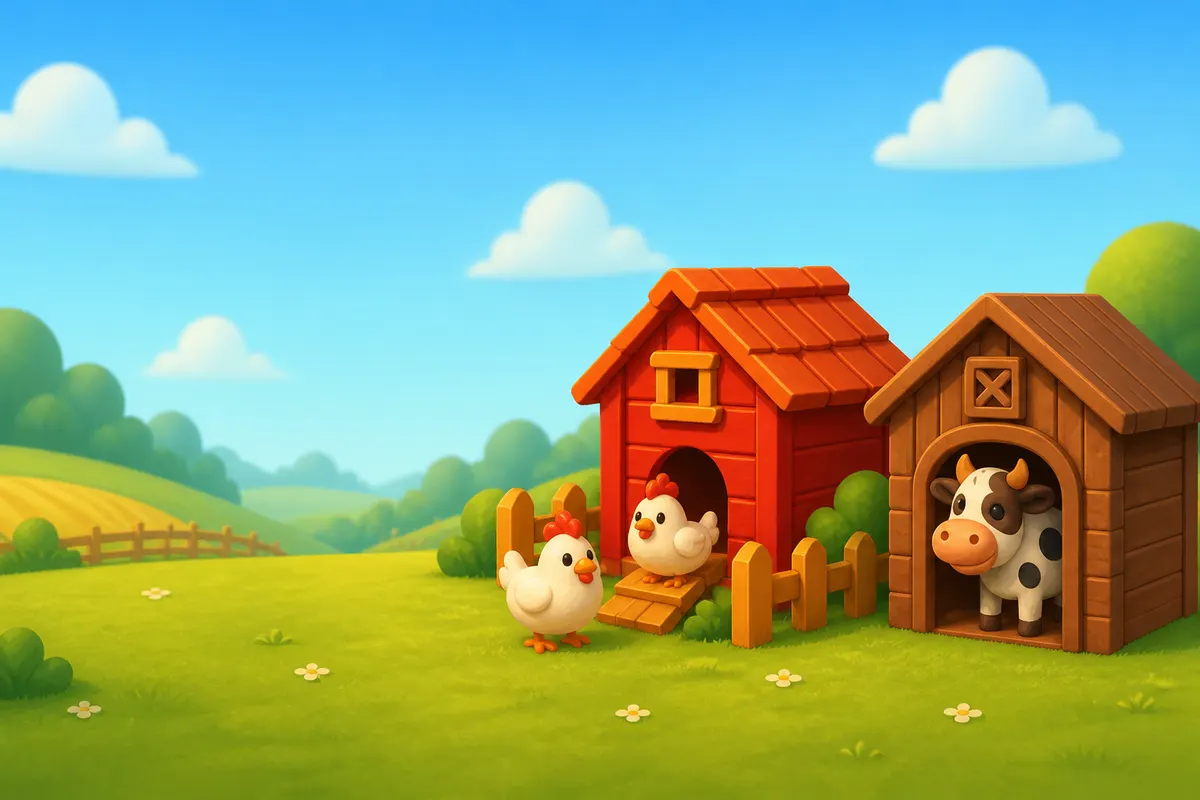
Animals are the second pillar of your farm. Crops give you grain and vegetables, but the eggs, milk, wool and honey from your animal buildings open up whole families of recipes: cakes, cheeses, scarves, teas and many more. This guide covers each animal building, the feed it needs, how upgrades work, and how to keep the whole barnyard humming with as little effort as possible.
How an animal building works
Every animal building follows the same simple loop:
- Feed it. One feed item starts one batch. The building does nothing without it.
- Wait. The batch has a timer. It shows on the building, and you get a notification if you allowed them.
- Collect. The goods go into your barn, and you earn a flat amount of XP for the collection. Your barn needs room for the whole batch, or the collection is refused.
- Feed again. A collected building is idle until you feed it again.
The amount per batch equals the building’s level. A Level 1 coop lays 1 egg per feed, a Level 4 coop lays 4, and a Level 8 coop lays 8, all from the same single feed. That makes upgrades the best deal on the farm once your recipes need animal goods.
Tip: Because a batch only starts when you feed, a full set of animals is the perfect “check in every hour or two” activity. Craft a handful of feed in advance, so a visit means feed, collect, done.
The seven animal buildings
| Building | Unlocks | Build cost | Base time | Product | Sells for | XP per collection | Feed |
|---|---|---|---|---|---|---|---|
 Chicken Coop Chicken Coop |
Level 9 | 400 | 15 min |  Egg Egg |
9 | 5 | Chicken Feed |
 Cow Shed Cow Shed |
Level 13 | 1,200 | 1 h 20 min |  Milk Milk |
25 | 8 | Cow Feed |
 Pigsty Pigsty |
Level 18 | 2,000 | 1 h |  Pork Pork |
25 | 10 | Pig Feed |
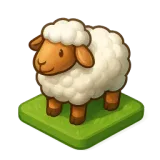 Sheep Farm Sheep Farm |
Level 27 | 2,200 | 2 h |  Wool Wool |
40 | 12 | Sheep Feed |
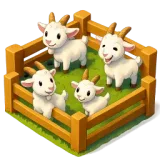 Goat Farm Goat Farm |
Level 33 | 3,000 | 1 h 40 min |  Goat Milk Goat Milk |
35 | 16 | Goat Feed |
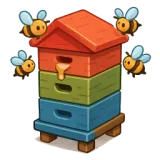 Apiary Apiary |
Level 43 | 4,200 | 2 h 30 min | 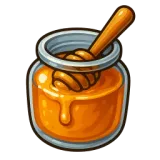 Honey Honey |
50 | 20 | Bee Feed |
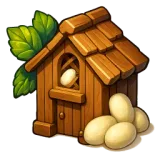 Silkworm House Silkworm House |
Level 51 | 20,000 | 3 h 30 min | 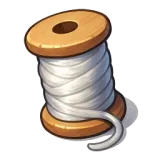 Silk Thread Silk Thread |
65 | 25 | Silkworm Feed |
Build costs are in coins. The times are for a Level 1 building and get shorter with every upgrade.
Good to know: The
Farm Map also has a separate Apiary building (Level 20) that fills with honey twice a day on its own. It is a different thing from the Apiary animal building above.
The feed chain
All feed comes from the Feed Mill
(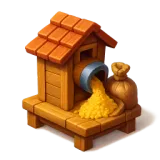 Feed Mill), which unlocks at Level 9 and costs 400
coins. Each feed is a quick craft from ordinary crops. The recipes unlock at the same level
as their animal.
Feed Mill), which unlocks at Level 9 and costs 400
coins. Each feed is a quick craft from ordinary crops. The recipes unlock at the same level
as their animal.
| Feed | Recipe unlocks | Ingredients | Craft time | Sells for |
|---|---|---|---|---|
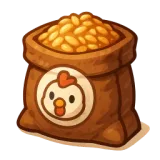 Chicken Feed Chicken Feed |
Level 9 | 3 Wheat, 2 Carrot | 5 min | 14 |
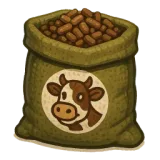 Cow Feed Cow Feed |
Level 13 | 3 Corn, 2 Wheat | 10 min | 20 |
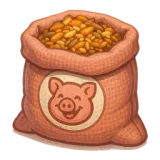 Pig Feed Pig Feed |
Level 18 | 3 Potato, 2 Corn, 1 Wheat | 20 min | 40 |
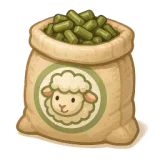 Sheep Feed Sheep Feed |
Level 27 | 2 Rice, 2 Carrot, 1 Wheat | 18 min | 30 |
 Goat Feed Goat Feed |
Level 33 | 2 Rice, 2 Soybean | 15 min | 35 |
 Bee Feed Bee Feed |
Level 43 | 2 Strawberry, 2 Sugarcane, 1 Cacao | 25 min | 50 |
 Silkworm Feed Silkworm Feed |
Level 51 | 3 Rice, 2 Cotton, 1 Soybean | 30 min | 60 |
Two things to remember. First, feed is just crops, so it is cheap: the cost of a feed is usually under 35 coins of crop value, and a Level 8 building turns that into 8 items. Second, feed is meant to be used, not sold or delivered, because it never appears in orders, visitor requests or boat crates. Crafting feed also gives a little XP, so a stack of it is never wasted.
The Feed Mill also makes Sanctuary Feed (Level 50) for the special animals of the
 Sanctuary, a separate feature that opens at the same level.
Upgrades: more per batch, faster batches
Every animal building can be upgraded to Level 8. Upgrades cost coins only and happen instantly. Each level gives you:
- +1 item per batch (level 8 means 8 items), and
- 5% shorter batches (level 8 batches are 35% shorter than level 1).
The coin cost grows quickly, so it pays to upgrade the building whose products you use most.
| Building | Upgrade cost to Level 8 (total) | Level 1 | Level 8 |
|---|---|---|---|
| Chicken Coop | 51,900 | 1 egg / 15 min | 8 eggs / about 10 min |
| Cow Shed | 118,300 | 1 milk / 1 h 20 min | 8 milk / about 52 min |
| Pigsty | 212,200 | 1 pork / 1 h | 8 pork / about 39 min |
| Sheep Farm | 233,300 | 1 wool / 2 h | 8 wool / about 1 h 18 min |
| Goat Farm | 317,500 | 1 goat milk / 1 h 40 min | 8 goat milk / about 1 h 5 min |
| Apiary | 432,500 | 1 honey / 2 h 30 min | 8 honey / about 1 h 38 min |
| Silkworm House | 1,977,000 | 1 silk thread / 3 h 30 min | 8 silk thread / about 2 h 17 min |
The first upgrade of a Chicken Coop costs 800 coins, the second 1,200, then 1,900, 3,200, 6,400, 12,800 and finally 25,600. The other buildings follow the same shape with bigger numbers. A sensible order is: Chicken Coop and Cow Shed first (they feed the most recipes), then whichever animal your current favorite recipes demand.
Extra buildings
You are not limited to one of each. Each animal type lets you build additional copies at higher levels, and every copy has its own timer, feed and upgrade level.
| Animal | Copies unlock at Levels |
|---|---|
| Chicken Coop | 9, 37 |
| Cow Shed | 13, 42, 70 |
| Pigsty | 18, 55 |
| Sheep Farm | 27, 62 |
| Goat Farm | 33, 77 |
| Apiary | 43, 83 |
| Silkworm House | 51, 91 |
Making batches even faster
On top of building levels, several things shorten every animal timer. They stack by multiplying:
 Animal Productivity (Upgrades tab, Level 24): each upgrade level takes 2.5% off animal
timers, up to 25% at Level 10.
Animal Productivity (Upgrades tab, Level 24): each upgrade level takes 2.5% off animal
timers, up to 25% at Level 10.- Hay Barn (Farm Map building, Level 27): 5% per level, up to 25% at Level 5.
 Coop perks: higher coop levels give a permanent animal speed bonus to every member.
Together with a Level 8 building, these can make a batch take less than half of its base time.
What are animal goods good for?
Animal products are used everywhere. Here is where they matter most.
- Egg:
 Cake at the Bakery,
 Egg Drop Soup and Fried Rice in the Kitchen,
and five Breakfast Cart dishes such as
Egg Drop Soup and Fried Rice in the Kitchen,
and five Breakfast Cart dishes such as
 Egg Sandwich,
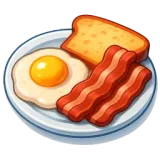 Farm Breakfast and
 Pancakes. Later it goes into Brioche, Macarons and
more.
Pancakes. Later it goes into Brioche, Macarons and
more. - Milk:
 Butter and
  Cheese
at the Dairy,
Cheese
at the Dairy,  Yogurt at the Creamery, Mashed Potatoes
in the Kitchen, and endgame treats like Aged Cheddar, Sweet Cream and Oat Porridge.
Yogurt at the Creamery, Mashed Potatoes
in the Kitchen, and endgame treats like Aged Cheddar, Sweet Cream and Oat Porridge. - Pork:
 Pork Chops,
 Smoked Pork,
 Smoked Sausage, Pork Stew and, later, Goulash
and Bone Broth.
Smoked Sausage, Pork Stew and, later, Goulash
and Bone Broth. - Wool:
 Wool Yarn at the Spinning Wheel, then Woolly Hat,
and in the endgame Plush Lamb and Felt Boots. Wool has fewer direct uses, but yarn leads
on to Knit Scarf, Cloth and Wool Cloth.
Wool Yarn at the Spinning Wheel, then Woolly Hat,
and in the endgame Plush Lamb and Felt Boots. Wool has fewer direct uses, but yarn leads
on to Knit Scarf, Cloth and Wool Cloth. -
**Goat Milk**: [Goat Butter](/tinyharvest/wiki/recipes#goat_butter),
[Goat Cheese](/tinyharvest/wiki/recipes#goat_cheese), Goat Yogurt, Lavender Soap and Goat
Milk Soap.
- Honey:
by far the most versatile product, with over 50 recipes: teas at the Tea House, tonics and
salves at the Apothecary, syrups and toffees, and many endgame dishes. Keep a stock.
-
**Silk Thread**: only a few recipes, but valuable ones: Silk Ribbon and
[Silk Cloth](/tinyharvest/wiki/recipes#silk_cloth), which together make the Couture Gown,
plus Bamboo Silk at the Loom.
Animal goods are also welcome in Valley projects. The Lake, the  Airport and the
  Spire all
ask for a stack of “Animal Goods” in their construction bars.
Spire all
ask for a stack of “Animal Goods” in their construction bars.
Letting someone else do the feeding
- Collect All / Feed All. The animals screen has buttons to collect from every ready building and to feed every hungry one with a single tap.
- The
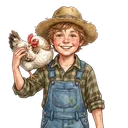 Animal Tender (Level 27) is a helper called Young Finn. You choose up to three
products and a stock target for each, and he collects and feeds your buildings to keep
your barn stocked, as long as you have feed and space. He works for a limited time that
you buy with a Helper Potion (8 hours) or diamonds (24 hours, 3 days or 7 days), and he
catches up on work for up to 4 hours after you have been away.
Animal Tender (Level 27) is a helper called Young Finn. You choose up to three
products and a stock target for each, and he collects and feeds your buildings to keep
your barn stocked, as long as you have feed and space. He works for a limited time that
you buy with a Helper Potion (8 hours) or diamonds (24 hours, 3 days or 7 days), and he
catches up on work for up to 4 hours after you have been away.
Common questions
- “Why is my animal not producing?” Almost always because it has not been fed since the last collection.
- “Can I sell feed?” You can, but you should not: nothing in orders or boats asks for it, and its value is tiny next to the animal goods it unlocks.
- “Which animal should I upgrade first?” The one that your best-paying recipes use. For most players that starts with chickens and cows, then honey.
- “Barn full?” Collections need space for the whole batch. Deliver orders or sell extras and try again.
For the money side of animals, see  Making Coins;
for crafting the goods, see
Making Coins;
for crafting the goods, see
 Crafting & Buildings.